
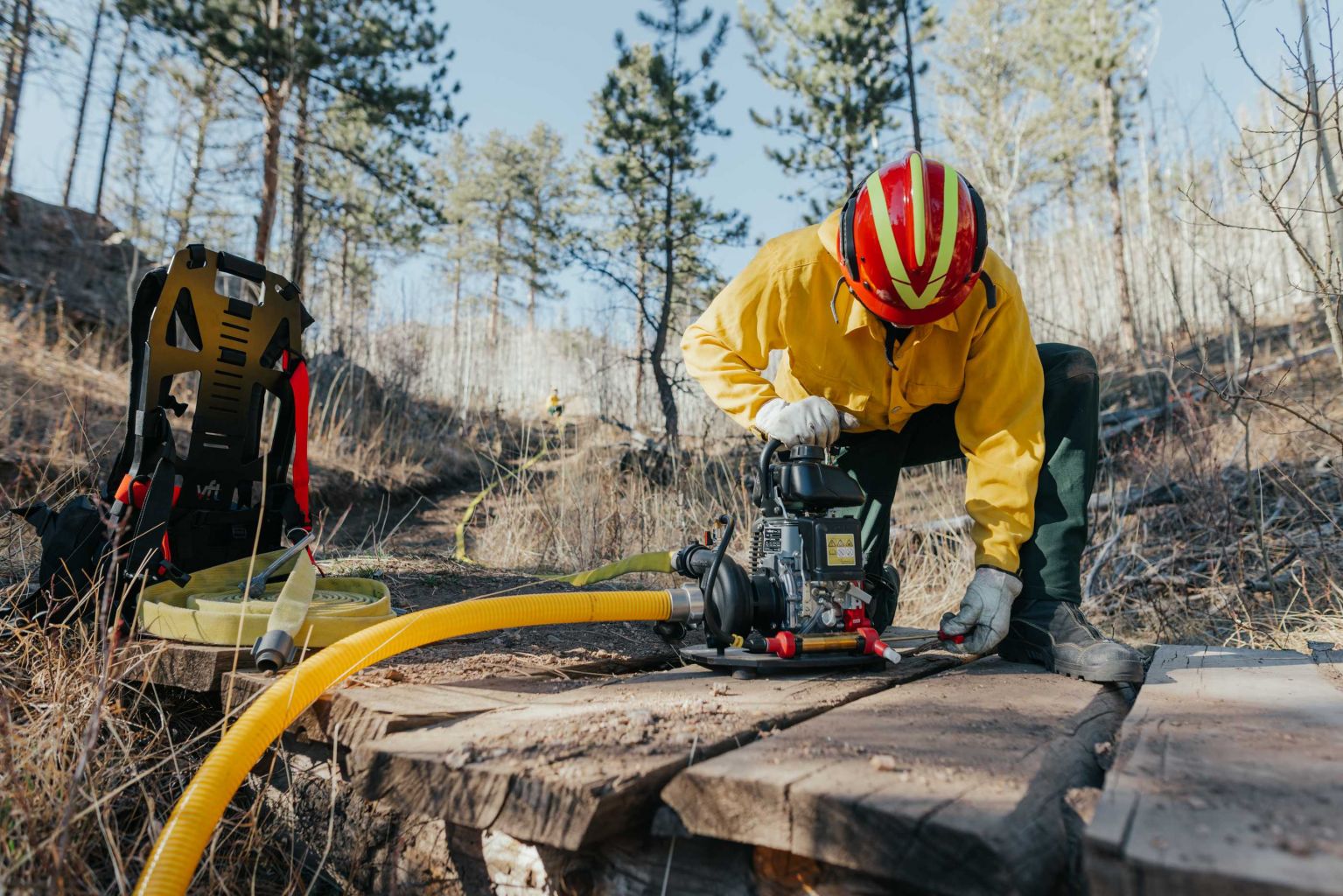
When the plane can’t reach it, when the fire engine can’t climb it, or when the road runs out, only one decision remains: what equipment to carry on your back. Portable fire pumps are units that generate flow and working pressure anywhere on the terrain without relying on a vehicle, a fixed supply network, or a pressurized water point. Choosing the right pump is not a minor decision: it determines the flow you can move, the pressure you’ll maintain at the nozzle and, ultimately, whether the fire stops where it needs to stop.
The need is not always the same. In some areas, all that matters is the weight a firefighter can carry on foot for hours. In others, light vehicles are available that can reach more difficult terrain, where the truck can’t go, and that can carry heavier portable pumps. That’s why Vallfirest manufactures two distinct families of portable pumps, each designed for a real-world scenario.
Vallfirest designs and manufactures wildland firefighting equipment used by crews and forest emergency services in different countries. The portable pump range has been developed specifically for forestry operations, where weight, pressure, flow, elevation change and ease of transport directly determine the maneuver on the ground. The configurations described in this article are based on field testing and on the experience of crews that regularly operate on long hoselays with significant accumulated elevation gain.
If you’d first like to understand how a fire pump works, how elevation affects a long hoselay, what configurations are used in the field, or what flow-selector nozzles are, we cover that in our previous article: Portable Wildland Fire Pumps: What They Are and How They Work.
Weight, Pressure, Flow: The Relationship That Defines the Design
Weight, pressure and flow are interdependent variables in the design of a portable centrifugal pump. Increasing the number of stages increases the maximum available pressure — each stage adds its own pressure increment, mounted in series on the same shaft — at the cost of greater weight and volume for the unit. Correct specification starts by identifying which variable is the critical constraint for each operation, and choosing accordingly.
The Vallfirest pump range is divided into two main families:
- Lightweight Series: 1, 2, 3 and 4-stage pump configurations optimized to minimize dry weight, with working pressures between 6.9 and 26.2 bar.
- Mediumweight Series: 2, 3 and 4-stage pump configurations optimized for high pressure and flow, with dry weight between 49 and 82 kg, assuming heavier transport.
Lightweight Series
Designed for the initial on-foot attack, in hard-to-reach areas where equipment weight is critical.
| Model | No. of stages | Max pressure | Max flow | Dry weight |
|---|---|---|---|---|
| BH1-4H | 1 stage | 6,9 bar | 260 l/min | 9,5 kg |
| BP2 | 2 stages | 12,4 bar | 474 l/min | 20 kg |
| BP4 | 4 stages | 26,2 bar | 370 l/min | 22 kg |
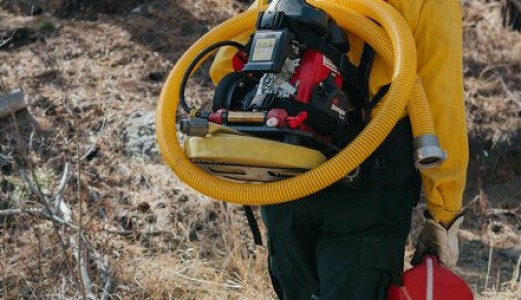
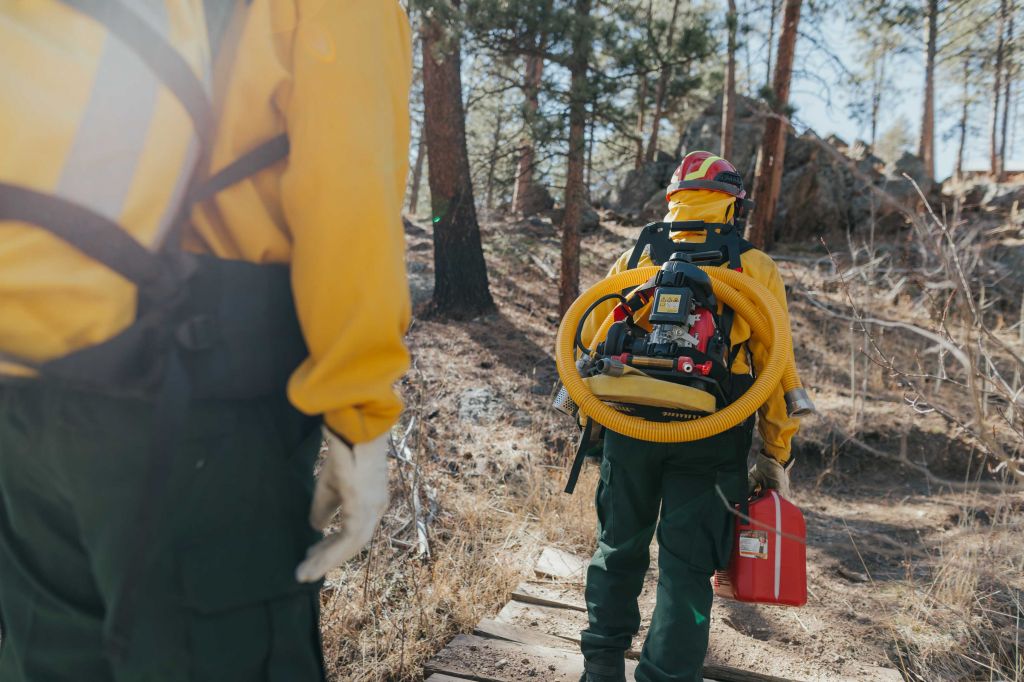
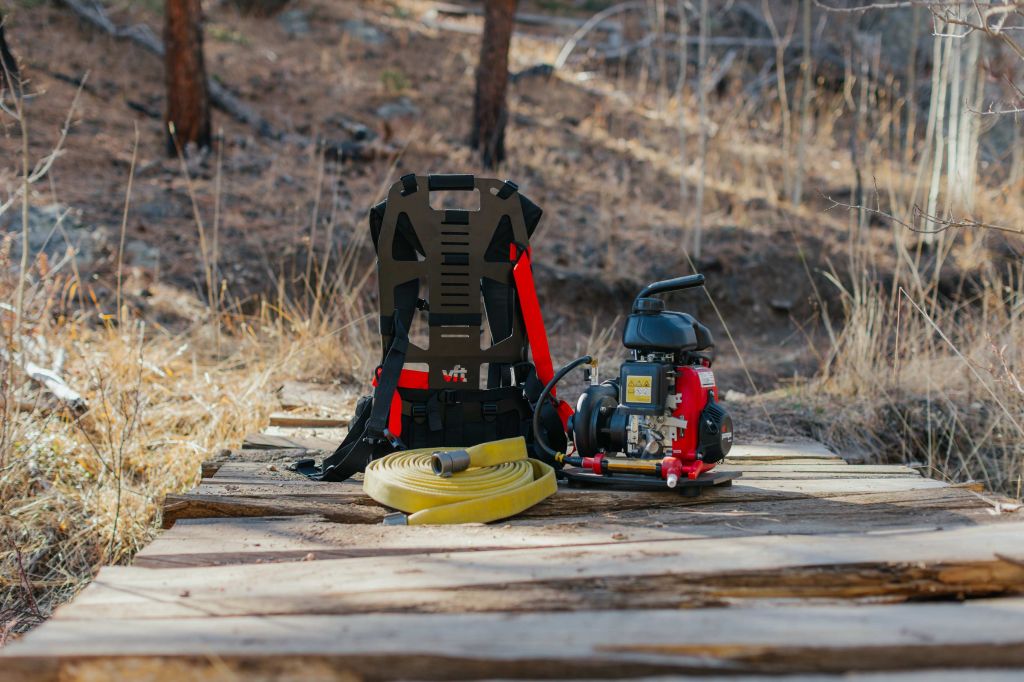
The BH1-4H, at just 9.5 kg, is the lightest option in the entire range, ideal for crews who need to carry the equipment on foot over long distances. A single firefighter can carry it on their back along with the suction hose, delivery hose and nozzle needed for its use.
The BP4, on the other hand, reaches pressures of up to 26.2 bar with just 22 kg of weight, thanks to its 4-stage centrifugal pump. The BP2 is designed for large flow volumes. In these cases, given the weight and volume of the pump, more firefighters are needed to carry the full equipment set: carrying backpacks, suction hose, delivery hoses and fuel tank.
Mediumweight Series
Designed for operations with higher flow or pressure requirements, where transport is done by vehicle and two firefighters are needed to lift and move the equipment short distances.
2-Stage Pump
The standard pressure range (10-16 bar) resulting from 2 impellers in series covers most direct-attack maneuvers with a nozzle on short-to-medium hoselays without significant elevation change: it’s the default configuration when there’s no specific head-loss constraint requiring more stages.
| Model | Max pressure | Max flow | Dry weight |
|---|---|---|---|
| BH2-10 | 10 bar | 360 l/min | 49 kg |
| BH2-13 | 14,5 bar | 523 l/min | 58,5 kg |
| BH2-18 | 15 bar | 520 l/min | 65 kg |
| BH2-21 | 15,5 bar | 504 l/min | 80 kg |
| BH2-23 | 15 bar | 520 l/min | 66,5 kg |
| BH2-18-HF | 13 bar | 1.130 l/min | 68 kg |
| BH2-23-HF | 13,5 bar | 1.130 l/min | 69 kg |
The -HF variants feature larger-diameter impellers with a wider passage, a geometry that shifts the flow-pressure curve’s design point toward higher flow at the expense of maximum pressure. This configuration is specified when the goal is water volume transfer: filling ponds, tanker trucks or portable tanks, or cascading supply to other pumps.
3-Stage Pump
The step up to 3 impellers (16-24 bar) is specified when the elevation change or hoselay length exceeds what 2 stages can compensate for. It’s the midpoint of the range, both in pressure and weight.
| Model | Max pressure | Max flow | Dry weight |
|---|---|---|---|
| BH3-10 | 16 bar | 270 l/min | 49,5 kg |
| BH3-13 | 23,9 bar | 345 l/min | 59,5 kg |
4-Stage Pump
With 4 impellers in series, the range’s maximum pressure (25-29 bar) is reached, sized for long hoselays with significant accumulated elevation gain, where head loss is the system’s dominant constraint: remember that every 10 m of elevation change costs roughly 1 bar of available pressure at the nozzle.
| Model | Max pressure | Max flow | Dry weight |
|---|---|---|---|
| BH4-13 | 25,8 bar | 380 l/min | 60,5 kg |
| BH4-18 | 28,8 bar | 397 l/min | 67 kg |
| BH4-21 | 28 bar | 333 l/min | 82 kg |
| BH4-23 | 28,8 bar | 397 l/min | 68,5 kg |
The 4-stage configurations reach a maximum of 28.8 bar while maintaining flows >300 l/min, and are sized to compensate for the system’s total head loss on long hoselays with positive elevation change. Head loss on a hoselay has two components: internal hose friction (a function of length, diameter and flow) and elevation loss, which follows the standard hydrostatic relationship of roughly 1 bar per 10 m of elevation change. On a 300 m hoselay with 150 m of accumulated elevation gain, the geodesic component of head loss alone can exceed 14 bar, before even adding hose friction loss.
Specification Criteria
Specification is resolved by applying three constraints in order of priority, each one narrowing the set of viable models for the next:
- 1. Mode of transport. On-foot access → Lightweight Series (9.5-22 kg) as the only viable option, regardless of pressure/flow requirements. Vallfirest has developed a carrying backpack, specialized for transporting Lightweight Series pumps. This backpack features a removable base, which makes it easier to carry slightly larger pumps such as the BP4. Vehicle or helicopter access → Mediumweight Series (49-82 kg) becomes available.
- 2. Head loss on the planned hoselay (length + elevation change). Short hoselays without significant elevation change: 1-2 stages are sufficient. Accumulated elevation change >100 m or hoselays >250 m: 3-4 stages are required for useful residual pressure at the nozzle.
- 3. Flow required by the maneuver. Direct attack with a nozzle: 270-520 l/min covers most standard configurations. Volume transfer (feeding hoselays, filling tanks, cascading supply): high-flow variants (BH2-13, BH2-21, or BH2-18-HF / BH2-23-HF > 1,100 l/min).
Quick Decision Table
For a first orientation, this table summarizes the recommended configuration based on your operation’s main need:
| Need | Recommended configuration |
|---|---|
| On-foot transport / minimum weight | BH1-4H |
| On-foot transport + higher pressure | BP4 |
| Standard extinction | 2 stages |
| Significant elevation change | 3–4 stages |
| Long hoselays | 3–4 stages |
| Large-volume transfer | HF |
| Filling tanks | HF |
Configurations and Accessories
All Vallfirest pumps are available in portable versions or for fixed installation on vehicles and extinction kits, including Vallfirest’s Skid Units. Full specifications, flow-pressure curves and accessories are available in the Vallfirest portable pump catalog.
To validate the optimal configuration for your hoselay, elevation change and mode of transport, contact the Vallfirest technical team or your local distributor.
Frequently Asked Questions
Which portable fire pump is best for wildland fires?
It depends on the mode of transport and the maneuver: for on-foot transport, the Lightweight Series (BH1-4H, BP2, BP4) is the only viable option; for operations with vehicle access and higher pressure or flow requirements, the Mediumweight Series (2 to 4 stages) covers most scenarios.
How much pressure does a wildland fire pump need?
Most direct-attack maneuvers with a nozzle on short or medium hoselays without significant elevation change are covered with 6-12 bar (1-2 stages). Long hoselays or significant accumulated elevation change require 3-4 stages, 14-28 bar.
What pump do I need to overcome 100 meters of elevation change?
From 100 m of accumulated elevation change onward, 3 or 4-stage configurations are recommended, as they provide the residual pressure needed at the nozzle after compensating for geodesic head loss.
How many bar are lost for every 10 meters of elevation change?
Approximately 1 bar per 10 m of elevation change, following the standard hydrostatic relationship. On a 300 m hoselay with 150 m of accumulated elevation gain, this component alone can exceed 15 bar.
What’s the difference between a 2, 3 and 4-stage pump?
Each stage (impeller) adds available maximum pressure at the cost of more weight and volume. 2 stages cover standard hoselays without significant elevation change; 3 stages are the midpoint; 4 stages reach the range’s maximum pressure for long hoselays with substantial elevation change.
Which pump can a single firefighter carry?
The BH1-4H, at 9.5 kg, is the lightest in the entire range and can be carried by a single firefighter along with the suction hose, delivery hose and nozzle.
What pump do I need to fill a portable tank?
For large-volume water transfer (filling ponds, tankers or portable tanks) the high-flow -HF variants are recommended, such as the BH2-18-HF or BH2-23-HF, delivering over 1,100 l/min.
What’s the difference between maximum pressure and working pressure?
Maximum pressure is the top value the pump can deliver under optimal conditions; working pressure is the actual pressure available at the nozzle once friction and elevation head losses along the hoselay are subtracted.