
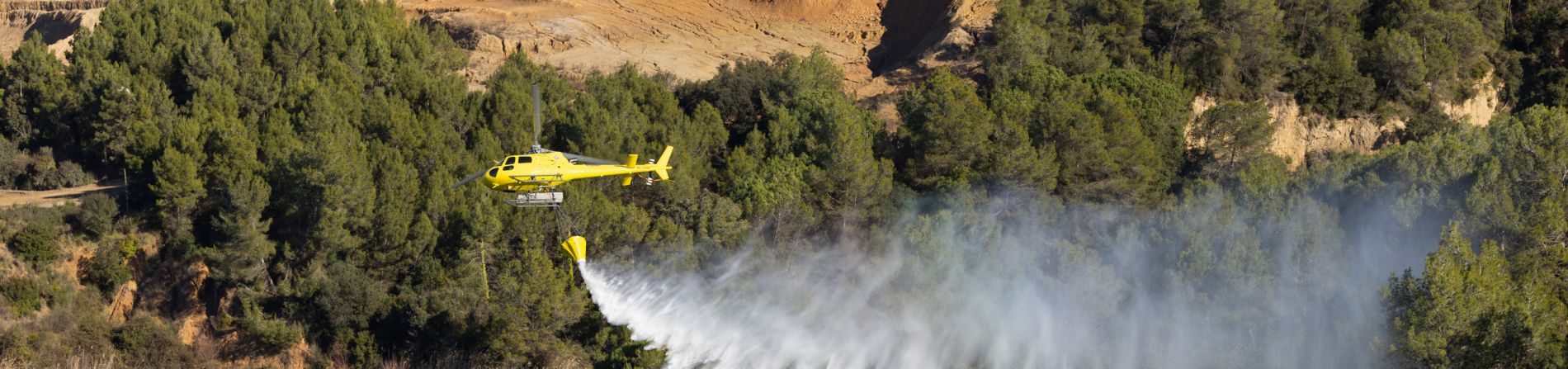
Aerial Firefighting – Many Tools Needed to Safely Do the Job
Bucket vs Tanks you ask? That is for another debate, another day - which is better or worse, the truth is they both have their operational roles, and many that have used both operationally will know very well the pros and cons of each. They will also know the price point differential and operational limitations of both once they complete their due diligence in advance. Same for fixed wing tankers, different tools that serve a different wildfire operational objective. Both are much needed, important aerial arsenal resources that support ground wildfire efforts alike.
Either way, our emergency response professionals will gladly take anything that is available when the fire weather indices climb, ignitions begin and major conflagrations begin to threaten people, property, critical infrastructure and precious ecosystems in our landscapes.
When it comes to aerial wildfire suppression, whatever aircraft is flying, the mission-critical equipment needs to be robust and reliable. The equipment you choose can be the difference between being awarded a services contract for flight revenue for the operator but can also be the difference between life and death for the emergency response professionals using these aerial assets during wildfire management operations. External load buckets with myriad water delivery valve systems have evolved significantly over the past decade — and today, operators see more bucket vendors and more options than ever before.
In this article, we break down some of the key differences between the Vallfirest Water Hog and both traditional and alternative helicopter bucket systems, helping you understand which solution may best fit your operational needs.
What Are Traditional Helicopter Buckets?
Traditional helicopter buckets are often flexible, collapsible, open-top fabric shells suspended beneath a helicopter cargo hook, often with a longline. The pilot manoeuvres over a water source, lowers and fills the bucket by submerging it, and then flies to the fire to release the water. Rinse and repeat, simple stuff, right? But wildfire operations are not simple anymore and the bucket technology needs to adapt to this change.
When industry-changing products came about in the early 1980s, for example, SEI Industries with founder Don Arney, who revolutionized the aerial firefighting market by offering a technological solution alternative to rigid buckets. His Bambi Bucket offered collapsible, fabric buckets with very simple valves to drop the entire load at the push of a button.
What made these legacy buckets revolutionary wasn’t the automatic water drop feature but more the capability to collapse the bucket, put it inside the helicopter and fly much faster without external load underneath (passenger transport not permitted with external loads on hook) and fly to a proximal location near the fire to start dipping from a water source. By having the bucket stowed onboard, operations could support transportation of initial attack crews that would start fire suppression efforts knowing that they had immediate air support on site with bucket loads cooling the fire and giving them a chance at fire extinction before the fire became too large and beyond initial attack capabilities. Initial attack failures result in sustained action fires and demand more resources, exponentially increasing suppression costs and risk exposure to firefighters and the public.
These types of buckets became the industry standard and even today, their single drop, full salvo drop valves, although very limited in terms of safety, efficiency and efficacy on our wildfire front lines, are still widely used across the world. They have proven effective in a range of historical wildfire scenarios. But are they what is being demanded by professionals now?
Global Wildfire Challenges – An Escalation of Dangerous Circumstances
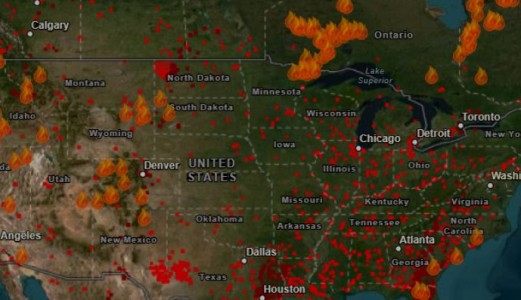
Our wildfire circumstances globally are very different than 20 years ago. Over the recent decade, the world has seen a rapid escalation of vegetation growth due to climate change. The world is warmer and with population increase lending to more anthropogenic fire starts and seemingly more naturally occurring fires from lightning ignitions. Wildfires are on the rise, not just in numbers but in areas lost. Some areas of the world that did not traditionally have wildfire events are now in annual risk exposures and finding the need to adapt faster, especially when neighboring jurisdictions are tapped out of resources themselves.
The wildfire behavior is off the charts; increased intensity, severity and embers transfers spewing all around due to high winds. Long range firebrands can catch high level winds and be extended several kilometers adjacent to fire perimeters, sparking new ignitions well in advance of already aggressive, well-organized fire fronts. The length of most fire seasons in many parts of the world is now weeks or months longer than previous years. Some traditional wildfire regions that used to see seasonal wildfire for 4-6 months are now seeing wildfire activity across 8-12 months of the year. Wildfire risk is an increasing global challenge.
The Bucket List – Responding to our Wildfire Challenges, Protecting our World
Our global population is at an elevated level of wildfire risk, loss and damage well beyond any previous period in recorded history. The challenge is that bucket technology must adapt and change to these circumstances. Many of the design and innovations were sparked by wildfire and aerial firefighting professionals that know the operations and see the need for innovation to better support wildfire operations. For example, the addition of ‘gated valves’ and ‘shallow fill’ or ‘foam injection’ capability are all mandatory requirements in most advanced wildfire management organizations. The innovations that led to the introduction of rigid (gated) valves in flexible, collapsible, fabric buckets were sparked from the fireline and now many of them come standard with most modern-day buckets. Some have designs and features that provide water delivery, but that also come with inherent operational limitations or sustained reliability issues that become highlighted during complex, fast-moving wildfire environments.
Typical characteristics of traditional buckets:
- Open-top design requires buckets to be fully submerged in deep water sources to fill up to maximum capacity. Current day drought challenges suitable dip sites near fires.
- Legacy buckets cannot automatically regulate volume – manual adjusted cinch straps require the pilot to land. This is very limiting because fuel volume onboard directly relates to aircraft payloads, bucket volumes; manual adjust is slow and disruptive.
- Heavy, valve actuator (control head) under the cargo hook requires regular maintenance protocols and spare parts to keep functioning throughout fire season.
- Fabric ‘udder’ valve has limited operational functionality; single drop only and not capable of load shedding (weight control) in dip site, partial drops, string drops, etc.
- Single drop valve requires routine maintenance and is more susceptible to wear and tear and shredding from repeated bucket dips in natural dip sites close to fires.
- Not a free-standing bucket; many fire & emergency services professionals occasionally need to fill the bucket manually when suitable dip sites are not immediately available.
- Shallow fill capability with ‘external’ retrofit kit but only with limited selection of models.
What is the Vallfirest Water Hog?
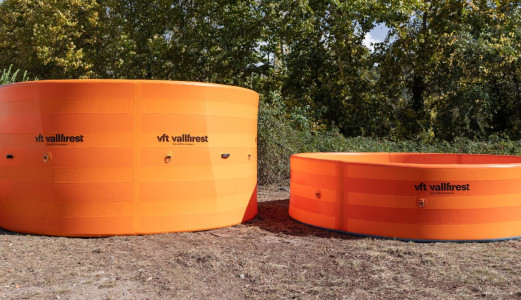
VFT Vallfirest's Water Hog is a modern helicopter firefighting bucket, purpose-built for firefighting with modern design innovation spanning 25+ years. The Water Hog was invented ‘by’ a helicopter pilot ‘for’ helicopter pilots, specifically designed to address the operational gaps in the aerial firefighting market seen over the years with traditional bucket systems.
The Water Hog offers a gated valve, with marine-grade, electrically activated, with a closed-hydraulic actuator in a rigid valve system. It offers unlimited multiple drops as standard capability in every bucket model. The Water Hog comes in over 25 models ranging from 15USG (60L) to 3,000USG (11,000L) to support a wide range of VTOL drone, helicopter types and operational wildfire scenarios. Most models have Shallow Fill, Foam Injection System accessories as production or retrofit by end users, and all wrapped in high tensile, high abrasion resistant, robust shells with structural battens to take a beating on the fire line and submerge very quickly in dip sites. Some of the models come with an optional ‘narrow base’ that allows for Water Hog buckets to be stowed and transported in external baskets.
Key technical features of Vallfirest Water Hog bucket:
- High-capacity drops; unlimited load shedding allows for maximum payload as the aircraft burns off fuel over flight duration on fires. More water on fire, in the fuel cycle.
- Precision drops allow targeted application on specific types of vegetation types, size and continuities: wide or narrow drop, split/full salvo drop or pilot adjusted coverage levels on string drops with automatic mode – time on trigger, push button pilot/crew control.
- Compatible with a wide range of helicopter platforms with over 25 models ranging from 60L (15USG) to 11,000L (3,000USG). Drone VTOL to CH-47 and everything in between.
- Rapid set up and deployment – collapsible, plug and play system, single pilot friendly.
- ‘Basket Bucket’ options available in select models; transport bucket in external basket.
- Stable in flight, with valve open or closed, stable at maximum VNE aircraft speed.
- Free standing bucket if required for top filling by fire & emergency services.
- Low maintenance with main consumable part, a low-cost, pinch-weld rubber seal.
- Aircraft 28VDC or 24VDC Power Pack option; 20A breaker, includes control box.
- Rapid Filler Port allows for quicker dips at water sources. Retrofit kits available.
- Shallow Fill options available across most models intermediate to heavy lift.
- Foam & water enhancer chemical injection systems compatible. Retrofit kit available.
- Robust construction – marine grade submersible hydraulic actuator valve system wrapped in tough fabric shell; proven operationally ready in real wildfire operations over 25+ years on global wildfires annually. The design fully supports sustained operations.
Real-World Performance
The Water Hog has been deployed in active wildfire operations across Europe, Latin America, Asia-Pacific, Australia and North America - including alongside Black Hawk, Super Puma and Bell 412SP helicopter missions during multi-agency, emergency fire missions steadily over the past10 years in Indonesia, Australia and Cyprus. The Water Hog has received very positive testimonials from end users for its demonstrated stability in flight at or near max VNE, rapid deployment, user friendly, seamless integration, supporting safe operations with high efficacy.
This operational track record is what separates a theoretically capable product from one that has been tested in multiple global locations over 25+ years - where it matters most, unrelenting in its reliability to provide continuous operational support to the operational wildland and emergency response personnel on the ground. You may not have seen the Water Hog much in North America yet, but with recent interest and adoption, you will soon!
Conclusion
Traditional helicopter buckets have served the wildfire community well for decades — and in straightforward scenarios, they continue to do so. But as wildfires grow in complexity, scale and intensity, the limitations of traditional systems become more apparent.
The Vallfirest Water Hog was designed precisely for these demanding environments: where precision, capacity, compatibility and reliability are not optional extras — they are operational requirements. The product is fully supported with manufacturing, product and service support based in Australia, Spain and the USA.
If you are evaluating aerial firefighting bucket systems for your fleet or operations at any level, we are happy to provide full technical documentation and support.
👉 Contact our team or download the Water Hog technical sheet for full specifications.
See the Water Hog in action on Vallfirest’s YouTube channel here.
Vallfirest designs and manufactures professional wildland firefighting equipment used by firefighters, air operators, wildfire and forest management professionals across the globe supporting efforts in over 85 countries. The Water Hog is part of the vft aerial product range.
| Feature | Traditional Bucket | Water Hog |
|---|---|---|
| Valve type | Fabric udder / single drop | Marine-grade gated valve |
| Drop options | Single salvo only | Unlimited, precision adjustable |
| Models available | Limited | 25+ (60L–11,000L) |
| Free-standing | No | Yes |
| Shallow fill | Retrofit only (select models) | Available across most models |
| Foam injection | Limited | Compatible across range |
| Maintenance | High | Low (rubber seal) |